

Research Drift: UFƟ DARK SKIES _ O% illumination
Research Collaboratory: Sophie Austin, Judith van den Boom, Fabrizio Cocchiarella, Nick Dunn, Tori Hydra, Emily Luce, Jessica Riquetti, Tess Wehmeyer + online participating audience sharing experience and prompts.
UFƟ centres phenomena because it seeks to engage directly with the unknown and the experiential processes that shape our realities. We treat these encounters not as mysteries to solve, but as opportunities to rethink how we perceive, relate, and design within an interconnected world. Through initiating drifts - whether online or situated - we resist predetermined outcomes and allow our events and gatherings to explore environments, ideas, and relations with openness. By drifting, we create space for playful and provocative encounters and embodied learning, transforming research into an act of attunement rather than constraint.
🌑 UFƟ DARK SKIES _ O% illumination
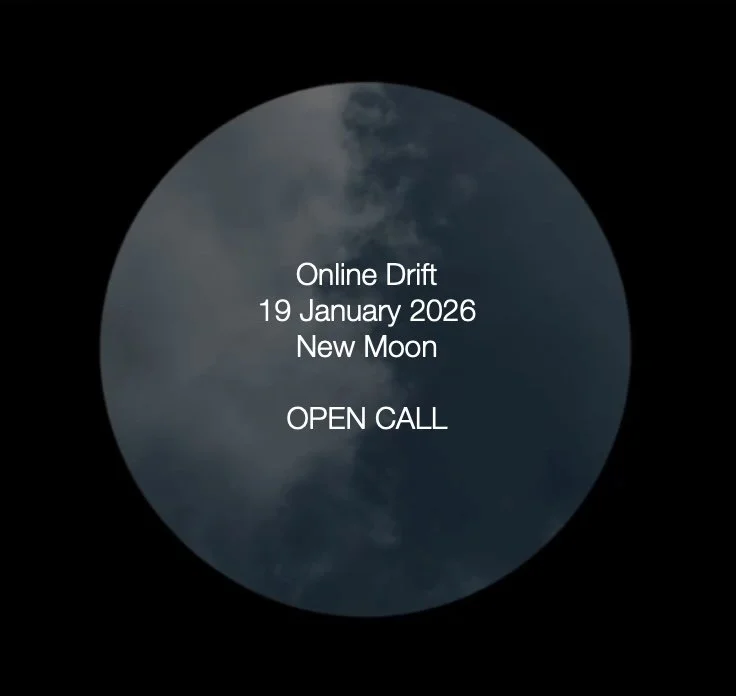
19 January 2026, new moon, 0% illumination. On this day, the moon positions itself between the sun and our planet, creating a deep, enclosing night. It marks a new lunar cycle, a moment of darkness at its fullest. UFƟ DARK SKIES coincides with Blue Monday, often called the most depressing day of the year. Rather than framing this day as one of gloom, we invite a different perspective: a conscious encounter with darkness as a living, vital space. We live in a moment when darkness is disappearing, from our skies, cities, knowledge and even our imaginations. Many of the old stories about darkness, its myths, its lessons and rituals, slip from our cultural memory. We are losing our understanding of how darkness is important for the living rhythm of our planet and its species. Nocturnal life is a central part of the balance in which our world grows.
Darkness is framed as absence or danger. Yet darkness is also a space of aliveness, where other rhythms, voices, and realities emerge. By portraying darkness as ‘bad,’ we risk excluding a vital part of our biological, ecological, cultural, and social understanding, the understanding that connects us to place, species, and the larger web of life.
We need to reframe and unpack the phenomena that are key to our existence. It’s a call to see the new stories forming: seeing the new patterns from ecological disturbance, cycles disrupted and light pollution.UFƟ DARK SKIES seeks an opening to let the darkness tell its stories and show how it informs our lives. In this drift we will take time to pause, share and practice. Creating spaces for the emerging of other rhythms, voices, and imaginations.
During UFƟ DARK SKIES, we invite multiple perspectives to explore how dark skies are not merely a backdrop, but an active, living field:
Ecological: the role of darkness in sustaining biodiversity and nocturnal ecologies
Cultural: myths, rituals, and traditions that honour or fear the dark.
Physiological: how darkness influences human health, connection and perception.
Biological: evolutionary adaptations to the dark and the interplay between light and life.
Futures narratives: speculative practices reframing darkness
Place-based narratives: local stories tied to landscapes.
Below from each of the 8 presentations a 1 min capture
Judith van den Boom Every night, trillions of plankton migrate vertically through the ocean, traveling hundreds of meters up and down. Darkness acts as the cue for this planetary-scale choreography. Through sonar readings of the ocean floor, we noticed the seabed rising when light faded but it wasn’t the floor moving; it was a dense layer of marine life, shifting up and down. This vertical migration is a pulse in the ocean, transporting energy, nutrients, and carbon, linking surface waters with the deep sea. Plankton comes from Greek, meaning ‘wanderer’ or ‘drifter.’ Plankton do not perceive the ocean as space, they experience it as timing and the darkness synchronizes millions of individual decisions.
What when we shift our thinking of darkness at atmosphere or absence and start seeing it as infrastructure? Something to care and design for? To design for darkness, we first need to understand who depends on it and how. We must expand our senses to perceive the world like the organisms that rely on it.
@greenandbeyond
Nick Dunn Darkness as a multisensory realm where identities dissolve and possibilities emerge. We dream in darkness. It speaks of other realms. Places after dark offer atmospheres which can stir imagination and creativity towards new ways of becoming. We can enter deep dialogue through such entanglements, thinking and moving through time and space in a multisensory and often uncanny way. Identities shift. Structures disassemble. Alternatives emerge. We share the night. It is a more-than-human world, especially after dark. Please close your eyes for a moment and think – what would a restored nocturnal commons mean for you?
@darkskythinking
Fabrizio Cocchiarella Paranormal belief as a design tool for imagination, critique, and connection. Psychologically, darkness reduces visual certainty. When we can’t clearly see, the brain fills in the gaps. Perception becomes less anchored in verification and more connected to memory, emotion and the subconscious. Carl Jung described this as the activation of archetypal material, symbols and narratives beneath conscious awareness. In this sense, paranormal belief is not irrational, it is deeply human.
@fcocchiarella
Tess Wehmeyer Darkness as a lived condition demanding fluid, shape-shifting intelligence. Hybrid Humans: Shapeshifting as a relational technology: I didn’t learn shape-shifting as a strategy; I learned it because the world made staying the same unsafe. When your body, mind, or way of sensing reality doesn’t fit the dominant order, you’re forced to learn how to move between worlds, when to bend, when to harden, when to disappear, and when to perform “normal” to avoid punishment. That’s why the Upside Down in Stranger Things isn’t fantasy to me: it’s the same systems, the same institutions, just stripped of warmth, protection, and belonging. For queer, trans, intersex, and neurodiverse people, darkness isn’t fear, it’s training, lived daily, teaching us how to read instability, survive collapse, and navigate what others refuse to see. So the question isn’t whether we can shape-shift, we already have but whether the world is willing to learn from those it tried to erase before it’s forced to.
@tesswehmeyer
Jessica Riquetti How living beings navigate, adapt, and persist through darkness toward light. Don’t assume there is no light, find alternative means to light.
Other’s strengths can support your weakness
Know your vulnerabilities
Signal your needs to others
Sense your environment and adjust
Be flexible in partnership/ let go
Find your own source of light
Sophie Austin I have found so much comfort under dark skies, but it wasn't always the case. For my story, I considered the effort I and fellow humans exert to keep the lights on. I wondered what the dark and our nocturnal neighbours must think of this. And ultimately I wondered about night and day who arrive without fail.
What is it about us humans who go to such unnatural efforts to stop the day from ending? In the story my character gives up on her efforts to create light and she finds magic, familiarity and peace in the darkness. May it be so for us all.
@sophiejanesnaps www.sophiejaneaustin.com
tori hydra Newfoundlanders experience old hag dreams more than anywhere else in the world. We wake in the middle of the night with the old hag sitting on our chest, restricting our breathing, showing up without warning. Similarly, the long-lasting impacts of covid and collective suffering have grabbed our global community by the throat, throwing us into sudden despair and fear much like our hag from the island. How has this shared experience of restricted living reshaped our relationship with our sensing bodies? How do our somatic systems reconstruct meaning through alternate sensory seeking?
@torihydra
Emily Luce For the exploration of dark/black/gallows humour, we take inspiration from the Surrealists, who held a conference around the subject and ultimately assembled their findings into Anthologie de l'Humour Noir. This work was followed by decades of analyses that unpack the mechanics of gallows humour, revealing methodologies for rewriting the narrative by utilising tension between the unsettling and the amusing. Let’s compile and publish an updated Anthology of Gallows Humour, 2026 edition. Anyone who notices ’the funny edge of the world,’ please send your submissions to emily@craftpeople.ca Collaborators are welcome on this project!
@emilyluce @c_r_a_f_t______/